
Worth Criminal Court Records
A criminal court record is the court case file, not the same thing as a jail roster, police report, or criminal-history background check. In Worth County, the Clerk of Courts files criminal cases and maintains criminal warrants. Superior Court handles felony criminal cases because Georgia Superior Court is the general-jurisdiction trial court. State Court handles misdemeanors and traffic cases. Magistrate Court handles arrest and search warrant applications, preliminary hearings, and pre-warrant applications. Municipal courts may handle city ordinance cases and city traffic matters that can generate bench warrants or failure-to-appear entries.
The criminal case file begins once charges are filed or court action starts. It may include a complaint, accusation, indictment, arrest warrant, bond order, arraignment entry, plea, motions, hearing notices, calendar settings, disposition, sentence, probation terms, restitution, fines, court costs, and revocation entries. For a closer look at the charging document and how charges change after an arrest, use the Worth County court charge records file. For the full criminal case outcome, stay with the clerk and court record.
The Worth County Sheriff official site is one local law-enforcement source connected to criminal cases, warrants, and custody records.

The Sheriff source is useful for arrest and warrant context, but the court case file and disposition must be confirmed through the court record.
Search Worth Criminal Court Records
Worth County does not provide one public criminal case database that covers every court and document with no account. Start with the court level. For felony criminal cases, begin with the Worth County Clerk of Courts because the Clerk files criminal cases and maintains criminal warrants. For misdemeanors and traffic cases in State Court, the same Clerk office may be involved. For warrants and preliminary hearings, Magistrate Court may have the first court event. For city tickets or municipal ordinance matters, search the city court or payment portal named on the citation.
- Identify the case level: felony, misdemeanor, traffic misdemeanor, warrant application, probation matter, or municipal case.
- Collect the defendant's full name, case number if known, approximate arrest or filing date, court name, and charge.
- Check the Tifton Judicial Circuit calendar for Superior Court event dates and judge settings in Worth County.
- Contact the Clerk of Courts for the case file, docket, disposition, sentence, or certified criminal court copy.
- Use statewide access tools such as Georgia Courts eAccess, re:SearchGA, and GSCCCA eCertification only where the record or copy workflow is available.
For active warrants, Georgia.gov directs people to the local sheriff and warns that an in-person warrant request can lead to arrest if a warrant exists. That warning belongs in criminal-record research because warrants and criminal cases overlap, but a warrant lookup is not a substitute for a disposition or sentence in the criminal court record.
Georgia.gov's warrant guide is relevant to Worth County criminal court records because active warrants can be part of the criminal case path.
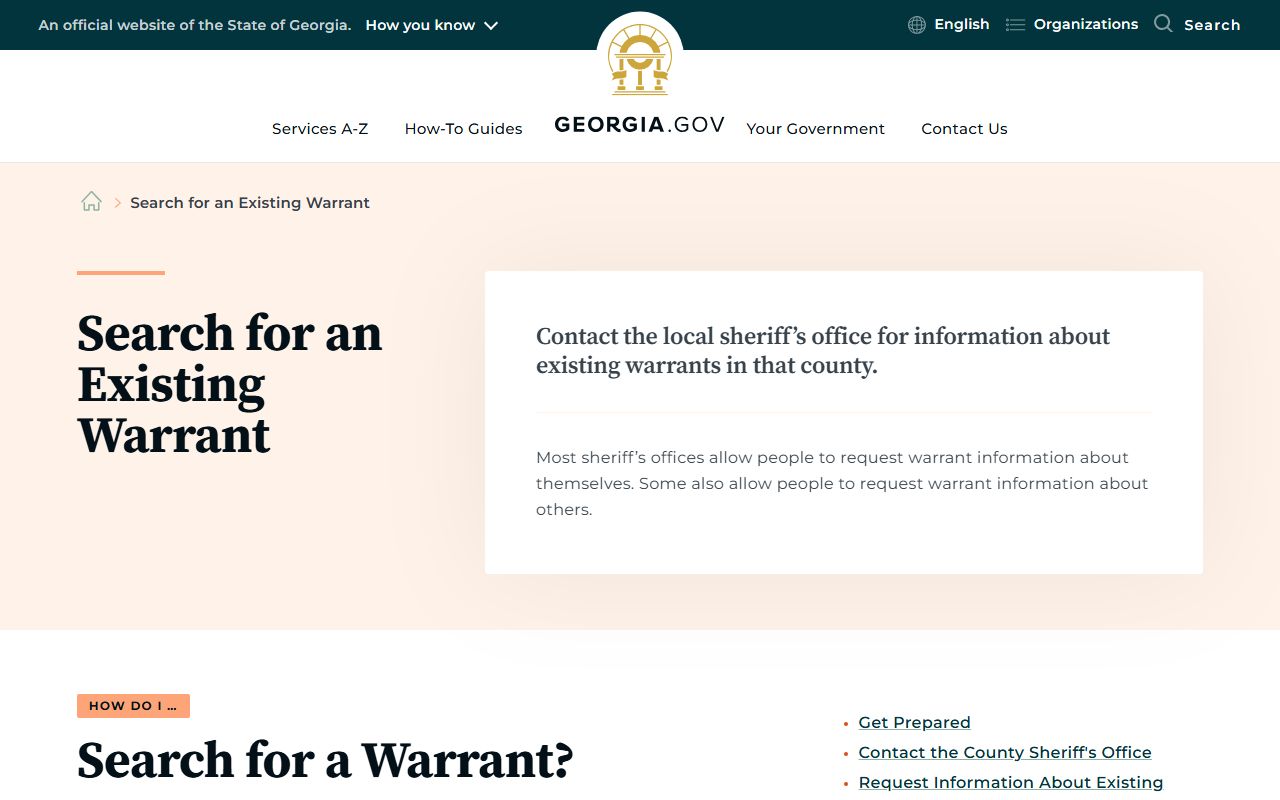
The state guidance reinforces that warrant status and court case status may require different offices and different records.
Worth Criminal Case Flow
Criminal court records are easier to read when each entry is tied to a case stage. A Worth County matter may begin with an arrest warrant, citation, complaint, or prosecutor filing. Felony cases move through Superior Court, while misdemeanors may proceed in State Court. Magistrate Court may handle the arrest warrant, search warrant, preliminary hearing, or pre-warrant application before a case is formally prosecuted. The docket should show enough of this movement to identify whether the case is pending, inactive, resolved, or still waiting for a hearing.
Case flow: Charges Filed › Arraignment › Pretrial / Motions › Plea or Trial › Disposition › Sentencing
| Stage | What Happens |
|---|---|
| Charges Filed | The accusation, indictment, complaint, warrant, or citation starts the formal criminal path. |
| Arraignment | Charges are presented in court and the defendant enters a plea such as guilty, not guilty, or nolo contendere. |
| Pretrial / Motions | The record may show bond hearings, discovery issues, suppression motions, continuances, calendar calls, and other hearings. |
| Plea or Trial | The case may resolve by plea or proceed to trial. A verdict or plea changes a charge record into an outcome record. |
| Disposition | The court records the result for each charge, such as guilty, dismissed, not guilty, dead docketed, or nolle prosequi. |
| Sentencing | The sentence may include jail, probation, fines, restitution, community service, conditions, or revocation terms. |
What Criminal Records Show
A Worth County criminal court record should be read field by field. The case number and court name tell where the file belongs. The defendant field identifies the person charged. Charge entries may include the statute, count, offense name, severity, warrant number, court, and sentence fields. The docket then shows arraignment, hearing dates, motions, plea, disposition, and sentencing. If the defendant was in custody, the jail or Sheriff record can provide booking context, but the court record controls the judicial outcome.
| Field | What It Shows |
|---|---|
| Case Number | The court tracking number used by the Clerk, court calendar, or portal. Use the exact number from court papers when possible. |
| Defendant | The person charged in the criminal case. Use full legal name and date context to avoid false matches. |
| Court | Superior, State, Magistrate, or Municipal Court, depending on case level and issuing authority. |
| Charges | Offense names, statutes, counts, charge type, warrant number, or accusation/indictment details. |
| Bond | Release terms, cash or surety bond, total bond, or bond-related hearing entries. |
| Plea | Guilty, not guilty, nolo contendere, or other formal response at arraignment or later proceedings. |
| Docket Events | Hearings, filings, motions, orders, calendar calls, trial settings, revocations, and disposition entries. |
| Disposition | The result for each case or charge, including dismissal, guilty plea, verdict, dead docket, or other status. |
| Sentence | Jail, probation, fine, restitution, conditions, suspended time, or court costs after conviction. |
| Restriction Status | Whether access is limited by juvenile confidentiality, sealing, Georgia record restriction, or redaction rules. |
Charges vs. Convictions
A charge is an allegation or filed offense. A conviction is a court outcome after a guilty plea, guilty verdict, or other qualifying adjudication. Worth County criminal court records can show charges that were later reduced, amended, dismissed, dead docketed, nolle prossed, or resolved by acquittal. Reading the charge line alone can misstate the result. Always check the disposition and sentence fields before treating a criminal court record as proof of conviction.
| Point | Charge | Conviction |
|---|---|---|
| Meaning | An offense alleged by warrant, complaint, accusation, indictment, or citation. | A court outcome after plea, verdict, or qualifying adjudication. |
| Timing | Appears early in the case and can change. | Appears after the court resolves the charge. |
| Record Risk | May remain visible even if the case ends without conviction. | May trigger sentence, probation, fines, points, or criminal-history reporting. |
| Best Field to Check | Charge, count, statute, type, and court. | Disposition, plea, judgment, sentence, and final order. |
Note: The full Worth County court records search path is better when a case includes civil, warrant, traffic, or probate material outside the criminal outcome.
Dispositions and Sentences
Disposition terms are short, and they carry legal weight. "Guilty" means the charge resulted in a conviction by plea or verdict. "Not guilty" means the court or jury did not convict on that charge. "Dismissed" means the charge was ended by the court or prosecution in that case. "Nolle prosequi" means the prosecutor did not proceed with that charge. "Dead docket" is a Georgia status where a case is inactive, but it should not be described as the same thing as an automatic dismissal or erasure.
Sentence fields should be read with the count and disposition. A record may list jail time, credit for time served, probation, fines, restitution, court costs, counseling, no-contact terms, license consequences, or revocation conditions. Some financial fields appear as fines, costs, restitution, probation fees, or surcharges. If the record is needed for legal, licensing, immigration, housing, or employment advice, use a certified copy from the Clerk and consult a qualified professional rather than relying on a portal summary.
Sealed vs. Expunged
Georgia commonly uses the term "record restriction" for criminal-history access limits. The Georgia Bureau of Investigation explains that O.C.G.A. 35-3-37 allows certain criminal-history records to be restricted for non-criminal-justice purposes. For arrests after July 1, 2013, GBI guidance says there is no application process through GBI and the person should contact the prosecutor. For arrests before July 1, 2013, the process starts with the arresting agency.
| Point | Sealed | Restricted / Expunged |
|---|---|---|
| Plain Meaning | A court file or part of a file is hidden from ordinary public access by law or court order. | Georgia record restriction limits access to certain criminal-history records for non-criminal-justice uses. |
| Where It Starts | Usually the court that controls the file and sealing order. | Prosecutor for many post-July 1, 2013 arrests, or arresting agency for older arrests under GBI guidance. |
| Effect | The public may not see the sealed file, but authorized users may still have access. | The GCIC criminal-history entry may be limited, but court, jail, and prosecutor records may not vanish at once. |
| Common Limits | Juvenile, adoption, mental-health, protected identifiers, and court-ordered sealed records. | Eligibility depends on charge, date, outcome, prosecutor action, and statutory rules. |
Public Access to Criminal Records
Georgia's Open Records Act and court rules support access to non-sealed public records, but Worth County criminal court records still follow court ownership and lawful restrictions. O.C.G.A. 50-18-70 states the public-record presumption. O.C.G.A. 50-18-71 covers inspection and copy procedures. Uniform Superior Court Rule 21 addresses public access to court records unless access is limited by law or court procedure.
Key Point: Public access to a criminal case is not the same as permission to use a record for FCRA-regulated screening decisions.
The Worth County Sheriff's department directory is useful when a criminal record question involves warrants, jail operations, investigations, or civil process rather than the final court disposition.
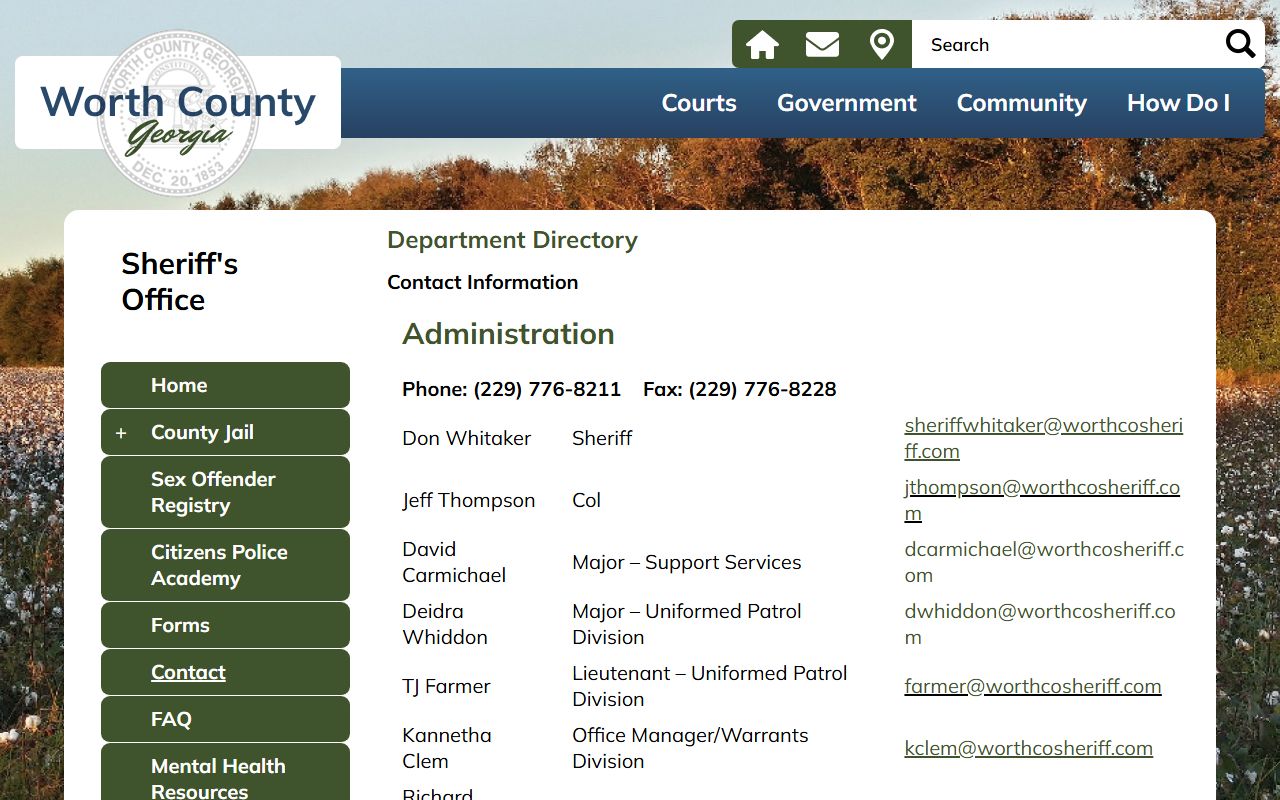
The directory helps separate law-enforcement contact points from the Clerk's role in maintaining criminal court records.
Criminal Histories and Reports
A court record search is not the same as a Georgia criminal-history report. The Sheriff's FAQ says criminal-history requests for employment require an in-person appearance, a required form, a $15 cash fee, and government-issued photo ID. That process is separate from asking the Clerk for a criminal case docket, disposition, sentence, or certified copy. Law-enforcement incident and crash reports are also separate records, requested from the Sheriff's Office during business hours and handled under Georgia Open Records Act rules.
Important: Verify criminal-history reports, employment checks, and certified dispositions through the official agency that issues that record.
The Sheriff's FAQ distinguishes reports, criminal-history requests, bond timing, medical care, and case-status contacts.
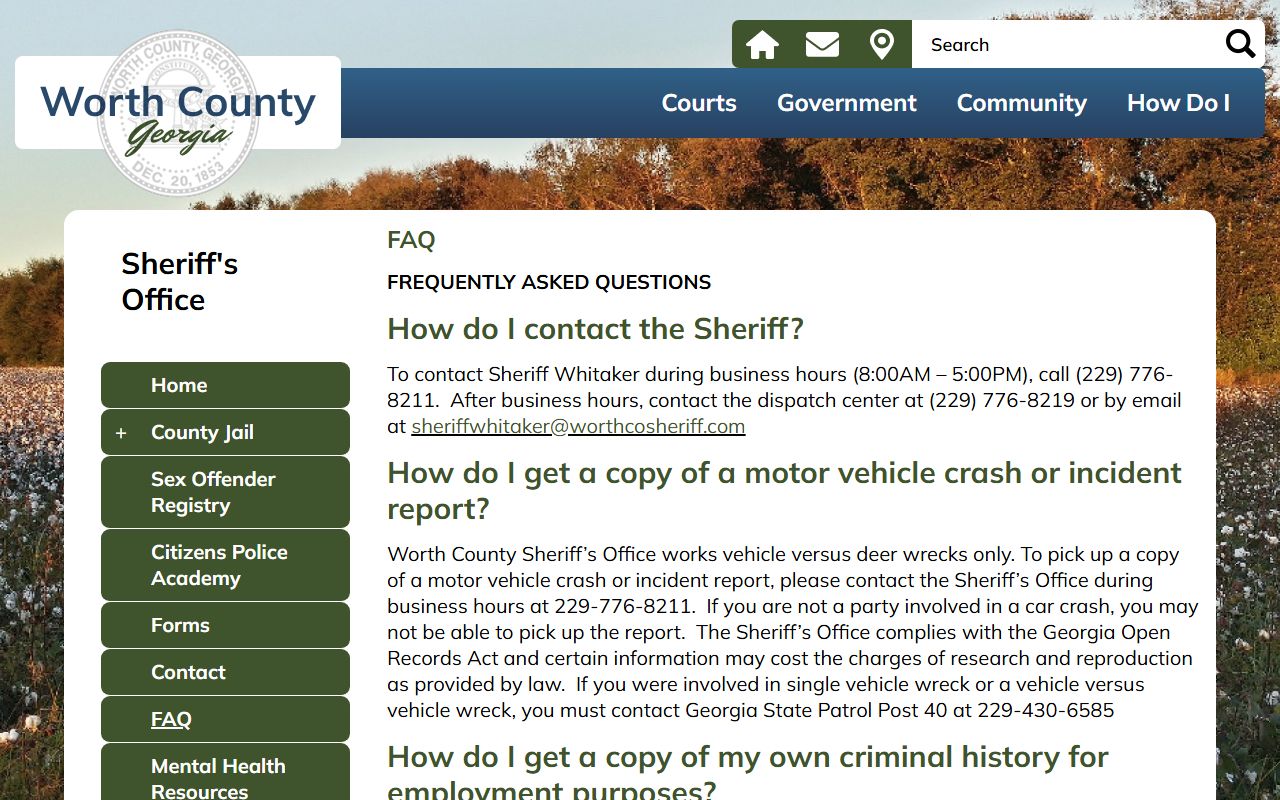
That FAQ helps prevent a common mistake: treating a Sheriff report, jail entry, warrant contact, and criminal court disposition as one record.
Restricted Worth Criminal Records
Several criminal-adjacent records have access limits. Juvenile delinquency, CHINS, juvenile traffic, dependency, and related child matters are handled in Juvenile Court and are not ordinary public criminal files. Sealed cases, sealed warrants, active investigative records, protected identifiers, medical information, and records restricted under O.C.G.A. 35-3-37 may be withheld or redacted. Adoption files and mental-health proceedings are separate record types but can appear in court-record searches, so they should not be treated as open criminal records.
For Worth County, the practical record-restriction path starts with identifying the record type: court case, GCIC criminal history, jail booking entry, warrant, or prosecutor file. A court disposition comes from the court. A criminal-history restriction question starts with the prosecutor for many newer arrests or with the arresting agency for older arrests. A jail booking or Sheriff report may have its own update path. These systems do not always update at the same time.
Worth County Clerk of Courts
201 N Main Street, Room 13
Sylvester, GA 31791
229-776-8205
Office hours 8am-5pm; phone hours 9am-5pm